 |
| Nicknames | Staffy, Staff, SBT, Stafford, Staffy Bull, [1] |
|---|
| [hide]Traits |
|---|
| Weight | Male | 14 to 18 kg (31 to 40 lb) |
|---|
| Female | 12 to 16 kg (26 to 35 lb) |
|---|
| Height | Male | 38 to 42 cm (15 to 17 in) |
|---|
| Coat | Smooth, short and close |
|---|
| Color | Red, fawn, white, black or blue, or any one of these colours with white. Any shade of brindle or any shade of brindle with white |
|---|
|
| [show]Classification and standards |
|---|
|
| Dog (Canis lupus familiaris) |
The
Staffordshire Bull Terrier (informally:
Staffie,
Stafford,
Staffy or
Staff) is a medium-sized, short-coated
breed of
dog.
[2] It is an
English dog, the fifth most popular breed, and related to the
bull terrier. Descended from
dog-fighting ancestors, it is muscular and loyal. It is the subject of
breed-specific legislation in some jurisdictions.
[edit]Description
[edit]Appearance
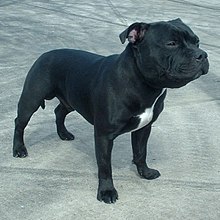
The Staffordshire Bull Terrier is a medium-sized, stocky, and very muscular dog, with a similar appearance to the
American Staffordshire terrier and
American pit bull terrier. It has a broad head (male considerably more so than female), defined
occipital muscles, a relatively short foreface, dark round eyes and a wide mouth with a clean scissor-like bite (the top incisors slightly overlap the bottom incisors). The ears are small. The cheek muscles are very pronounced. The lips show no looseness. From above, the head loosely resembles a triangle. The head tapers down to a strong well-muscled neck and shoulders placed on squarely spaced forelimbs. They are tucked up in their loins and the last 1-2 ribs of the ribcage are usually visible. The tail resembles an old fashioned pump handle. The hind quarters are well-muscled and are what give the Stafford drive when baiting. They are coloured brindle, black, red, fawn, blue, white, or any blending of these colors with white. White with any other colour broken up over the body is known as pied. Liver-colored, black and tan dogs can occur but are rare. The coat is smooth and clings tightly to the body giving the dog a streamlined appearance.
The dogs stand 36 to 42 cm (14 to 17 in) at the
withers and weigh 14 to 18 kg (31 to 40 lb) for males; females are 11 to 15.4 kg (24 to 34 lb).
[3]
[edit]Temperament
Although individual differences in personality exist, common traits exist throughout the Staffords. Due to its breeding, and history, the Staffordshire Bull Terrier is known for its character of intelligence, fearlessness and loyalty.
[4] This, coupled with its affection for its friends, its off-duty quietness and trustworthy stability, make it a foremost all-purpose dog.
[5] It has been said that "No breed is more loving with its family".
[6]
The breed is naturally muscular and may appear intimidating; however, because of their natural fondness for people, most Staffords are temperamentally ill-suited for guard or attack-dog training. Staffordshire Bull Terrier puppies are very easy to house train.
[7]
[edit]Press on bad behaviour
Since the British
Dangerous Dogs Act made it illegal to own breeds such as the pit bull terrier, the press have reported many cases of attacks by Staffordshire Bull Terriers or dogs described as a "Staffordshire bull terrier cross" on children, adults and family pets.
[8][9][10][11][12][13] The RSPCA fears that breeders are renaming
pit bull terriers as Staffordshire bull terriers to avoid prosecution.
[14]Also, the description "Staffordshire terrier cross" is frequently a euphemism for a dog such as the
American Pit Bull Terrier. However, the Staffordshire bull terrier, like all dog breeds, is capable of dangerous behavior.
Several
New South Wales state government reports analysing dog attacks have identified the Staffordshire bull terrier as the leading breed of dog responsible for biting humans (ahead of the
Australian Cattle Dog,
German Shepherd and
Jack Russell Terrier) in that state.
[15][16][17] However, an earlier report into breed specific legislation observed the likely reason for breeds most popular in Australia, such as Staffordshire Bull Terriers and their crosses, being represented as having a higher involvement in aggressive behaviour towards humans is due to sheer number of them in the community, and that it is still only a small percentage of animals within these breeds that cause issues.
[18]
[edit]Affinity with people
Staffordshire Bull Terriers are friendly, enthusiastic and usually extremely affectionate towards humans. They express their affection through jumping up, nuzzling, licking
[19] and pawing, and even when trained can still be 'fussy' with owners and others. Staffordshires are perhaps not suitable pets for those who prefer quiet, reserved dogs. Staffordshires are notably adaptable in terms of changing home or even owners, and unfortunately this can make them easy prey for
dognappers.
[20]
RSPCA chief vet Mark Evans said: "Staffies have had a terrible press, but this is not of their own making - in fact they're wonderful dogs. If people think that Staffies have problems, they're looking at the wrong end of the dog lead! When well cared for and properly trained they can make brilliant companions. Our experience suggests that problems occur when bad owners exploit the Staffie's desire to please by training them to show aggression."
[21]
[edit]Breed-specific legislation
The Staffordshire Bull Terrier is subject to breed-specific legislation in various countries, which ban members of the
Bull and Terrierfamily.
[edit]History
Before the 19th century,
bloodsports such as
bull baiting,
bear baiting and
cock fighting were common. Bulls brought to market were set upon by dogs as a way of tenderizing the meat and providing entertainment for the spectators; and dog fights with bears, bulls and other animals were often organized as entertainment for both royalty and commoners.
Early
Bull and Terriers were not bred to resemble the companion animals of today, but for the characteristic known as
gameness, with the pitting of dogs against bear or bull and exotic animals testing this attribute along with the strength and skill of the dog. These early "proto-staffords" provided the ancestral foundation stock for the Staffordshire Bull Terrier, the Bull Terrier, the American Pit Bull Terrier and American Staffordshire Terrier. This common ancestor was known as the "Bull and Terrier".
These bloodsports were officially eliminated in 1835 as Britain began to introduce
animal welfare laws. Since
dogfights were cheaper to organize and far easier to conceal from the law than bull or bear baits, bloodsport proponents turned to pitting their dogs against each other instead. Dog fighting was used as both a bloodsport (often involving
gambling) and a way to continue to test the quality of their stock. For decades afterward, dog fighting clandestinely took place in pockets of working-class Britain and America. Dogs were released into a pit, and the last dog still fighting (or occasionally, the last dog surviving) was recognized as the winner. The quality of pluckiness or "gameness" was still highly prized, and dogs that gave up during a fight were reviled as "curs." Despite being trained to be aggressive towards fellow dogs, they had to be of good temperament with people as the handler would have to bring the dog back to scratch for each round.
As time went on the modern breed has become one with a temperament suitable for a pet and companion. It gained respectability, becoming a dog worthy to show, and was accepted by
The Kennel Club of the
United Kingdom as the Staffordshire bull terrier in 1935.
[5] Examples of the breed currently found in the United States have no local fighting history, being descendants of the later show dogs who migrated over the Atlantic from the United Kingdom.
[edit]Breeding
[edit]England
The breed attained recognition by the Kennel Club on 25 May 1935. The Staffordshire Bull Terrier Club was formed in June 1935, one month after the breed was recognised by the Kennel Club. It is unusual for a breed to be recognised without a club in existence first, and even more unusual for there not to have been a breed standard in place. A standard was not drawn up until June 1935 at the Old Cross Guns, a
Black Country pub in Cradley Heath in the
West Midlands. A group of 30 Stafford enthusiasts gathered there and devised the standard, as well as electing the club's first secretary, Joseph Dunn, a well-known figure connected with the breed. Challenge certificates were awarded to the breed in 1938, and the first champions were Ch. Gentleman Jim (bred by Joseph Dunn) and Ch. Lady Eve (owned by Joseph Dunn), both taking titles in 1939. During the 1980s owners started to breed from old British lines also importing Staffordshire Bull Terriers from Ireland which they believed to be truer to the original of the pre showing days. These dogs are often referred to as Irish Staffordshire Bull Terriers. Media reports often refer to this as a cover name for breeders to sell pitbulls illegally.
[22]
Staffordshire Bull Terriers are known to suffer from Hereditary Cataracts (HC) and L-2-hydroxyglutaric aciduria (L2HGA)—a metabolic disorder resulting in behavioural changes and dementia-like symptoms—both of which are detectable via DNA tests.
[24]
Distichiasis (commonly known as “double eyelash”) and Persistent Hyperplastic Primary Vitreous (or PHPV)—a condition whereby the blood supply to the
ocular lens fails to regress and fibrovascular tissue forms causing hazy vision—both of which are checked by way of an ocular examination throughout the life of a breeding stud or brood-bitch to minimize the transfer and spread of these conditions.
The breed is known to be at a higher risk from
mastocytoma (mast cell tumours) than the general population of dogs.
[25]
A UK Kennel Club survey puts the median lifespan at 12.75 years.
[26]


